K5C vertical panels: single or double sided, no-parking or mini K5C, how to choose?
Single or double sided, right or left face, class 1 or class 2, 18 or 28 kg base, no-parking version or mini K5C for narrow roads: a guide to choosing the right K5C panel for the job.
“Which K5C should I order?” Our distributors and rental customers ask us this question regularly. The panel looks simple, but you have to choose the face, the film class and the base, and each of these choices depends on where it will stand. A mistake goes unnoticed when ordering, but not once the panel is in place: it then steers drivers to the wrong side.
This article reviews these choices for the two models we distribute: the Wemas K5C and the mini K5C.
What is a K5C for?
The K5C marks the position of an obstacle or a works zone on the public highway. It is temporary signage, but temporary in a lasting sense: ballasted on its base, it stays in place for several days, or even several weeks. To signal a sudden hazard, such as an accident, a K5a cone is preferred, as it is lighter and quicker to deploy. To choose the right one, see our complete guide to traffic cones.
It is found in most worksite layouts:
- works on the carriageway or the verge, to mark out the closed area;
- road narrowing, when traffic has to go through a tighter passage;
- alternating traffic or a temporary one-way section;
- contraflow, when both directions are temporarily moved onto the same carriageway without a separator;
- marking a temporary centre line;
- changes to the traffic plan for the duration of the works.
In the first cases, the panel stands at the roadside; in the last ones, in the middle of the road. That position determines which faces to order.
What the regulations say
In France, the K5C is an alignment panel under the interministerial instruction on road signage (Part 8, temporary signage). It belongs to the K5 family of devices, together with K5a cones, K5b posts and K5d guidance markers. These devices mark the limits of a worksite or a temporary obstacle, and must be placed close enough together to form a screen.
The installation rule to remember concerns the red and white stripes: they slope down towards the side of the road left open to traffic. That slope tells drivers which side to pass on, so it determines which face to order.
As for dimensions, the regulations describe the K5C as alternating red and white stripes at 45°, with a height between 600 and 1,000 mm and a width between 120 and 250 mm. They require nothing more. Over the years, however, some conventions have been added to make everyday use easier, such as the shape of the end fittings.
Chevron K5Cs: single or double sided
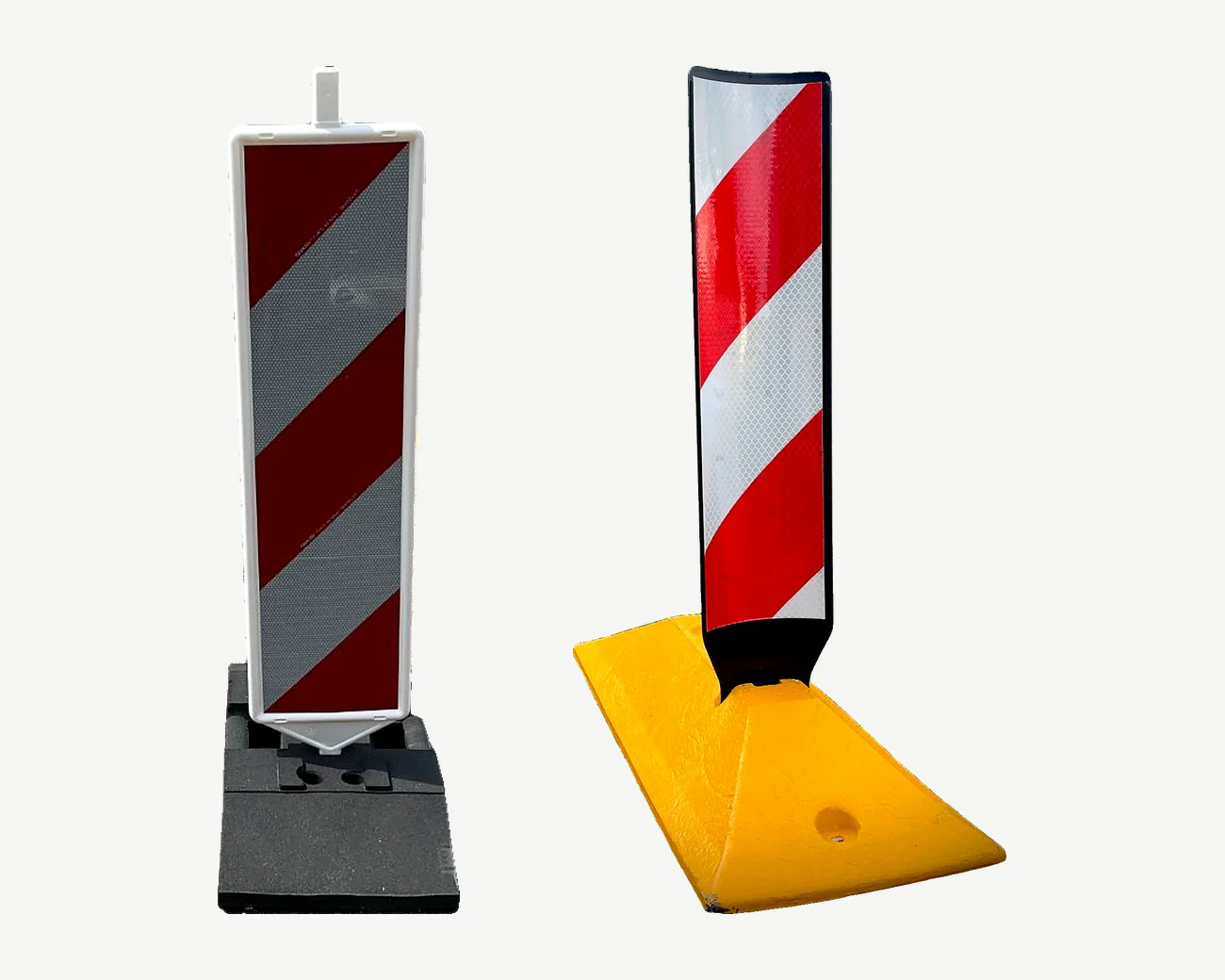
Right face and left face
Each face of a K5C is called right or left according to the side of the road where it stands:
- a right face stands on the right of the road. Its chevrons slope down to the left, towards the lane left open to traffic;
- a left face stands on the left of the road, or in the middle. Its chevrons slope down to the right.
The name of the face therefore refers to its position, not to the direction of the chevrons, which is often a source of confusion.
Single sided: right or left
The single-sided K5C carries chevrons on one side only, as a right face or a left face. It only guides drivers approaching it head-on. This version exists, but it is much rarer.
Double sided right/left, the most common
The right/left double-sided K5C carries a right face on one side and a left face on the other. Placed at the roadside, it guides both directions of traffic correctly: drivers who have it on their right see the right face, while those coming the other way, who have it on their left, see the left face.
It is the model you see most often, because it covers many situations. It is also the one we recommend keeping in stock: a single reference is enough to mark both edges of a road.
Double sided left/left, for the middle of the road
The left/left double-sided K5C carries a left face on both sides. It stands in the middle of the road, between two directions of traffic: each driver has it on their left and sees chevrons sloping down towards their own lane.
Class 1 or class 2
The logic is the same as for cones: class 1 suits urban use, class 2 is required on unlit secondary roads. The Wemas K5C comes in both classes, with Orafol 5931 film in class 2 and 3M 7310 film in class 1.
The base and the lamp
The Wemas K5C, made of 2.35 kg anti-UV white HDPE, fits into a base through its reversible 40 × 40 mm end fittings. We offer two bases, both made from 100% recycled materials in Germany:
- the 28 kg base, 800 × 400 mm, the most widely used in France;
- the 18 kg base, 595 × 395 mm, more compact and easier to handle, often used in towns or in private car parks.
The top fitting can also hold a K5 site lamp. Its automatic dusk switch-on makes the layout more visible at night, without any action from the crew.
The mini K5C, for narrow roads
The mini K5C is used almost exclusively for lane separation on narrow roads, or to split a one-way carriageway in two. The idea is to separate lanes while taking up as little space as possible. Its flexible black body carries a 64 × 14.5 cm blade with a 13.5 × 49 cm retroreflective film, single or double sided, in class 1 or class 2.
It fits onto an 8 kg yellow base with a 40 × 40 mm opening and, above all, a fitting specially designed for the mini K5C. This base can be fixed to the ground with lag bolts when the layout has to stay in place.
The no-parking K5C
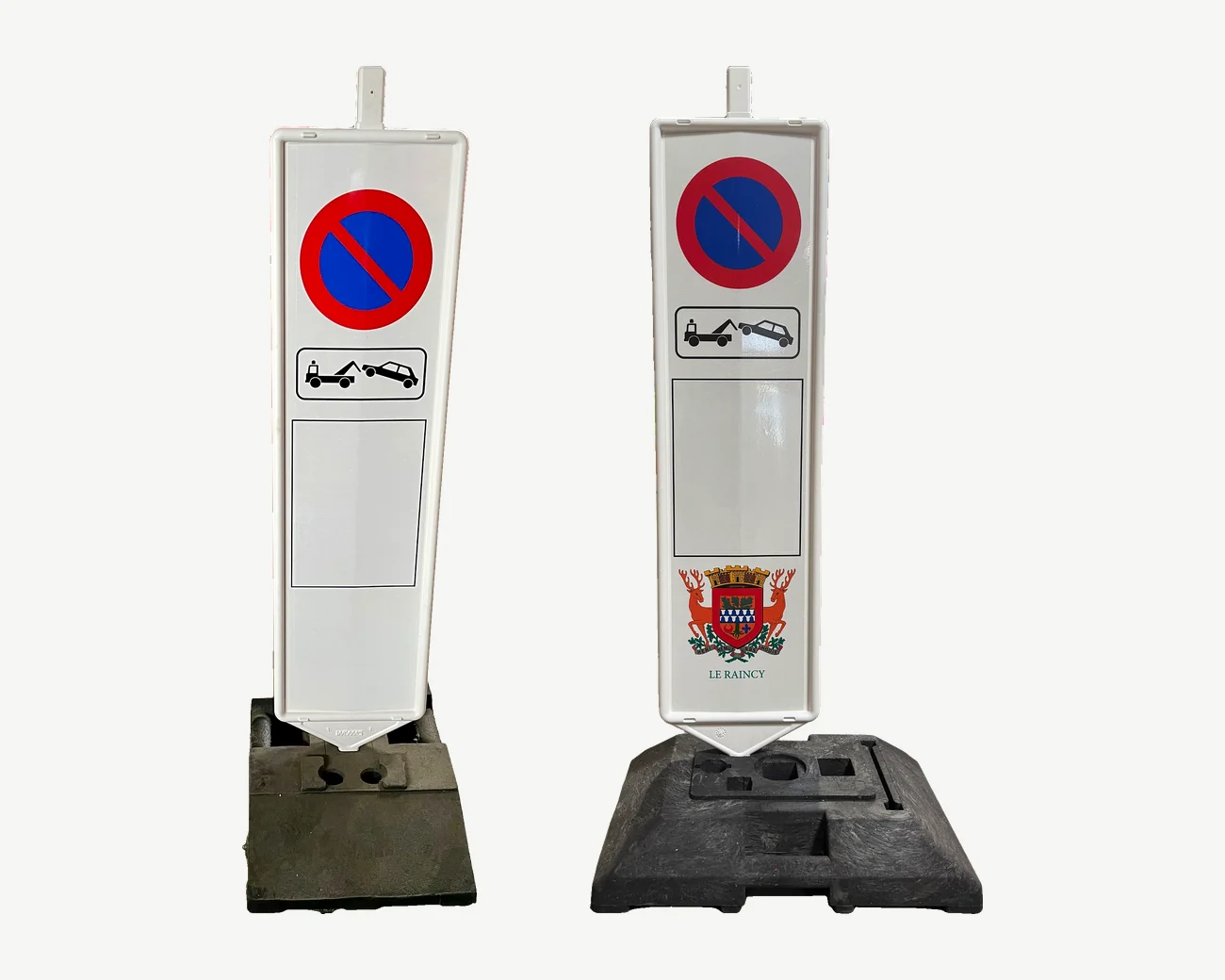
Our no-parking K5C is identical to the chevron K5C, but instead of chevrons we apply a specific design made up of a B6a1 sign (no parking) and the tow-away pictogram. It also has a pouch to hold the order on which the parking ban is based, and comes single or double sided.
It can also be customised: the bottom of the panel can carry, for example, a town’s coat of arms or logo. A local authority can therefore have several versions to suit its needs.
Quick reference
| Need | Model | Faces | Base |
|---|---|---|---|
| Roadside (works, road narrowing, temporary one-way section) | Wemas K5C | Double sided right/left, or single sided right or left | 28 kg base, or 18 kg in towns and private car parks |
| Middle of the road, between two directions (centre line, contraflow) | Wemas K5C | Double sided left/left | 28 kg base, or 18 kg in towns and private car parks |
| Lane separation on a narrow road or one-way carriageway | Mini K5C | Single or double sided | 8 kg yellow base, can be bolted down |
| Temporary parking ban | No-parking K5C | Single or double sided, with pouch for the order | 28 kg base, or 18 kg in towns and private car parks |
In every case: class 1 in towns, class 2 on unlit secondary roads.
Frequently asked questions
What is the difference between a right face and a left face?
The right face stands on the right of the road: its chevrons slope down to the left, towards the lane left open to traffic. The left face stands on the left or in the middle of the road, and its chevrons slope down to the right. The right/left double-sided K5C combines both on one panel, which makes it the simplest option for a rental fleet.
Which base should I choose for a Wemas K5C?
The 28 kg base is the most common in France. The 18 kg base is more compact and easier to handle and transport: it is often chosen in towns or in private car parks. Both take the panel’s 40 × 40 mm end fittings.
Does the mini K5C replace the standard K5C?
No. The mini K5C meets a specific need: separating lanes while taking up as little space as possible, on a narrow road or a one-way carriageway. To mark out a worksite or the edge of a works zone, the Wemas K5C remains the reference.
Need K5Cs for your fleet?
Are you a distributor or a rental company? Our team will help you put together the right configuration (panel, faces, class and base) and prepare your stock orders. Contact us or write to contact@ehsgroup.fr. If you are an end user, we will direct you to the distributor in our network closest to you.
Find all our panels on the technical datasheets page, and, for the retroreflection rules for cones, our article on the EN 13422 standard.
Sources
A question about our products?
Our team is here to advise you.